SDK
Developer guide
Configuration, integration points, and reference material for applications running on the SERGEANT framework.
The SERGEANT SDK exposes the framework's public surface: component APIs, message schemas, correlator control, configuration, and the development toolchain for building and validating applications that run on the SERGEANT / MAGNOM platform.
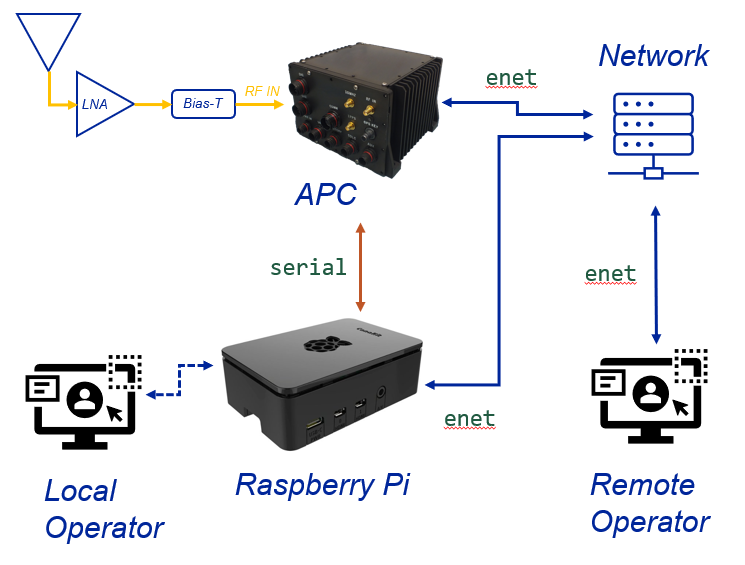
System topology
Reference integration: antenna → LNA → Bias-T → APC receiver → Ethernet network, with a serial-connected Raspberry Pi control surface and local/remote operator workstations.
Operational use cases
-
GNSS Tracking Channel Configuration
Configure channel count, acquisition parameters, and tracking-loop bandwidths per signal.
-
Configure Receiver Outputs
Configure LOS, PVT, and raw telemetry output streams for the integrated host platform.
-
Hot Start
Load YUMA almanac and RINEX 2/3 ephemeris to accelerate time-to-first-fix after power-on.
-
Multi-Constellation Solution
Configure the PVT solution to consume measurements across GPS and additional GNSS constellations.
-
Anti-Jam Configuration
Configure anti-jam processing and RF chain settings for operation in contested environments.
-
Anti-Spoof Configuration
Configure anti-spoof processing and authentication modes.
Integration surface
- Component APIs — typed message interfaces for each SERGEANT component.
- Correlator control — software access to programmable-logic correlators via the GEnCor layer.
- Configuration — structured configuration files for channels, acquisition, and receiver outputs.
- Measurement outputs — LOS, PVT, and raw telemetry streams to the host mission computer.
- Almanac / ephemeris loading — YUMA almanac and RINEX 2/3 for hot-start acceleration.
- Test harness — programmatic scenarios for unit, component, and system-level validation.
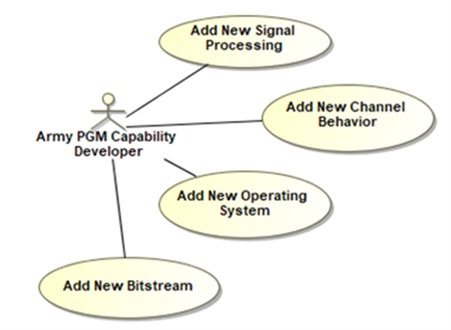
Capability developer extension points
The SDK opens four extension points for third-party capability developers — new signal processing, new channel behaviors, alternate operating systems, and new programmable-logic bitstreams.
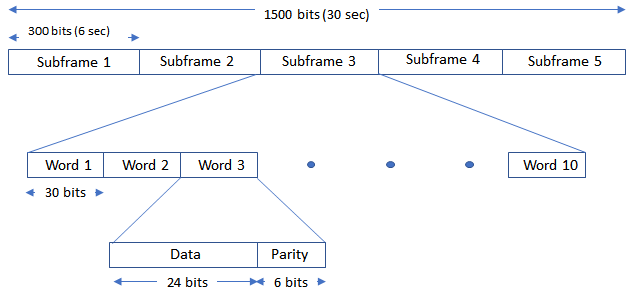
Civil GPS signal reference
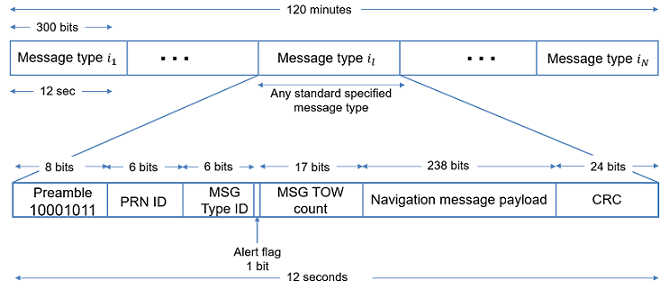
Developers integrating navigation-message decoding against the SERGEANT channel outputs will recognize these reference structures from IS-GPS-200 (L1 C/A LNAV) and IS-GPS-705 (L5 CNAV).
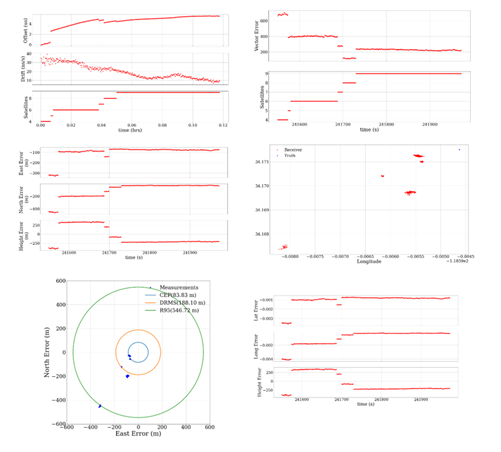
Receiver output
A representative receiver performance dashboard — clock offset and drift, satellite count, East/North/Height error traces, and a CEP/DRMS/R95 scatter for the position solution. The kind of artifact that drops out of the SDK once a run completes.